
Best Golf Club for Beginner: A Practical, Fitting‑First Guide
Choosing the best golf club for beginner players is less about copying a pro's bag and more about matching design features to real needs: forgiveness, easy launch and consistent distance gaps. This article explains how those priorities translate into driver and wood choices, iron profiles, short‑game tools and a fitting mindset that helps new golfers improve faster.
Quick answer
The best golf club for a beginner is a forgiving, easy‑launch design chosen through progressive fitting so lofts and shafts create consistent gaps and playable ball flight.
What you will learn here
- Why forgiveness and launch matter more than copying elite setups.
- How driver/wood and iron design affect a beginner's ball flight and miss‑management.
- Practical gapping and fitting priorities for a simple, effective set makeup.
DRIVER, WOODS, AND LONG‑GAME IDENTITY
For beginners the driver and fairway woods should answer two questions: can the club launch the ball high enough to be playable, and does it limit the penalty for off‑centre strikes? Industry reporting and manufacturer messaging identify modern game‑improvement drivers and woods as engineered for higher launch and increased moment of inertia (MOI), which preserves ball speed on mis‑hits. That combination produces more consistent tee shots for higher‑handicap players and reduces the frequency of catastrophic misses.
Rather than chasing lower spin or extreme workability, beginners benefit from larger MOI heads, lower/back centre‑of‑gravity locations and face technologies that expand the effective sweet spot. That means a long‑game identity based on forgiveness and predictable carry rather than shaping every shot like a low‑handicap player.
IRONS, SHAFTS, AND DISTANCE CONTROL
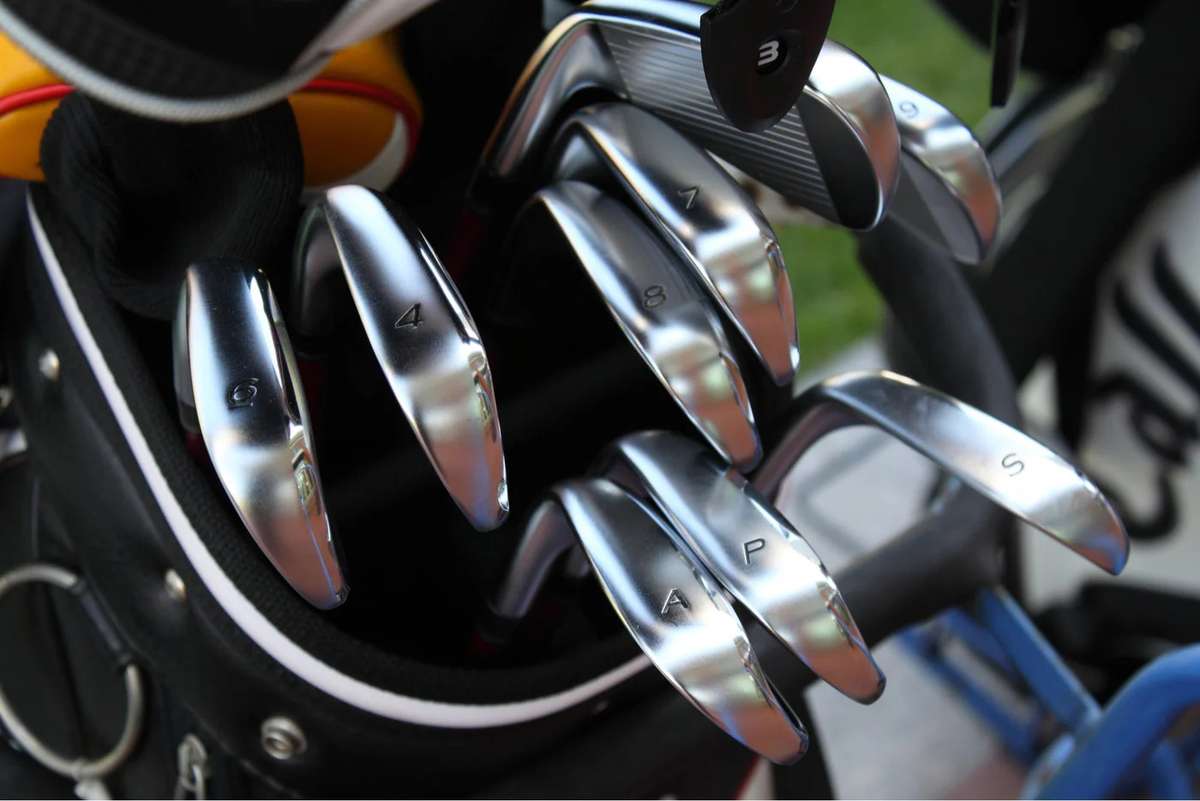
Irons marketed for beginners and game‑improvement players are built to raise launch and protect ball speed on off‑centre strikes. The essential fitting logic for beginners: pick iron heads that offer perimeter weighting and higher launch, then match shaft flex and weight to swing speed so the clubs produce consistent distance. Manufacturers and testing outlets stress that progressive fitting — measuring launch, spin and actual carry distances — is superior to simply copying set makeup from elite players.
Gapping is central: many golfers experience uneven distance gaps between clubs, which complicates club selection on the course. Experts advise checking lofts and measured carry gaps and then arranging irons and hybrids so each club covers a predictable range. For beginners this typically means fewer long irons and more hybrid‑style or easy‑launch options to smooth large gaps.
WEDGES, FEEL, AND SCORING SHOTS
Short‑game clubs for beginners should prioritise versatile bounce and consistent launch rather than extreme grind specialisation. The core objective is predictable distance control and playable turf interaction. Equipment guidance recommends selecting wedges that complement the iron gapping plan so loft steps remain sensible into scoring distances. For new players, having wedges that deliver repeatable contact and modest forgiveness is more valuable than a set of highly specialised grinds.
PUTTER CHOICE AND GREEN‑READING PERSONALITY
Putter selection ties directly to what a golfer does on the greens. For beginners the emphasis is on confidence and repeatability: mallet or blade options with forgiving face technology and alignment aids can help establish a stable putting stroke. The broader point from equipment guidance is that clubs should support a player's developing technique—not force the player into a complicated style because a particular head is fashionable.
BALL SELECTION AND FLIGHT LOGIC
Ball choice matters for launch and feel. Advice aimed at beginners focuses on using balls that promote higher launch and lower spin around the green to reduce volatile outcomes from mis‑hits. Manufacturers and testers show that pairing forgiving clubs with a ball designed for predictable flight and controlled spin produces a more usable on‑course performance for new golfers.
PROGRESSIVE FITTING: WHY IT WORKS FOR BEGINNERS
Progressive fitting means measuring a player's swing and launch conditions, then selecting clubs that create even gaps and suitable trajectories. Industry materials and manufacturer guidance emphasise this as the right path for beginners: it prevents the temptation to imitate stronger lofts and player‑oriented designs used by professionals and instead focuses on equipment that matches a player's present capabilities.
Practically, progressive fitting for a beginner will check launch angles, carry distances and shaft interaction, then prioritise forgiveness, correct shaft flex and sensible loft steps. That produces a set that offers consistent choices on the course and a clearer development path as the player's technique improves.
WHAT THE EQUIPMENT SAYS ABOUT THE GOLFER
A bag built for a beginner signals priorities: risk management, repeatability and learning efficiency. Forgiving drivers and woods show a willingness to accept some distance trade‑offs for more playable misses. Game‑improvement irons and hybrid replacements for long irons indicate a focus on reducing penalty shots and improving approach consistency. Wedges with practical bounce and a forgiving ball choice reflect an emphasis on scoring reliability rather than stylistic nuance.
In short, equipment choices reveal a player who values steady progress and clear feedback over emulating elite aesthetics. That is exactly the mindset manufacturers and fitters recommend for early development.
CLOSING: BUILD A SET THAT TEACHES
The best golf club for a beginner is not a single model but a set‑up philosophy: choose forgiving, easy‑launch clubs and use progressive fitting to ensure consistent gapping and suited shafts. This approach reduces penalties, improves shot repeatability and gives new golfers a practical learning environment. Rules bodies allow any conforming clubs within the 14‑club limit, so beginners have the freedom to build a forgiving, well‑gapped set that helps them play better and enjoy the game more.
Author: {Alex R.}