
Eagle in Golf Explained: Two Under Par, Why It’s Rare, and Par‑5 Chances
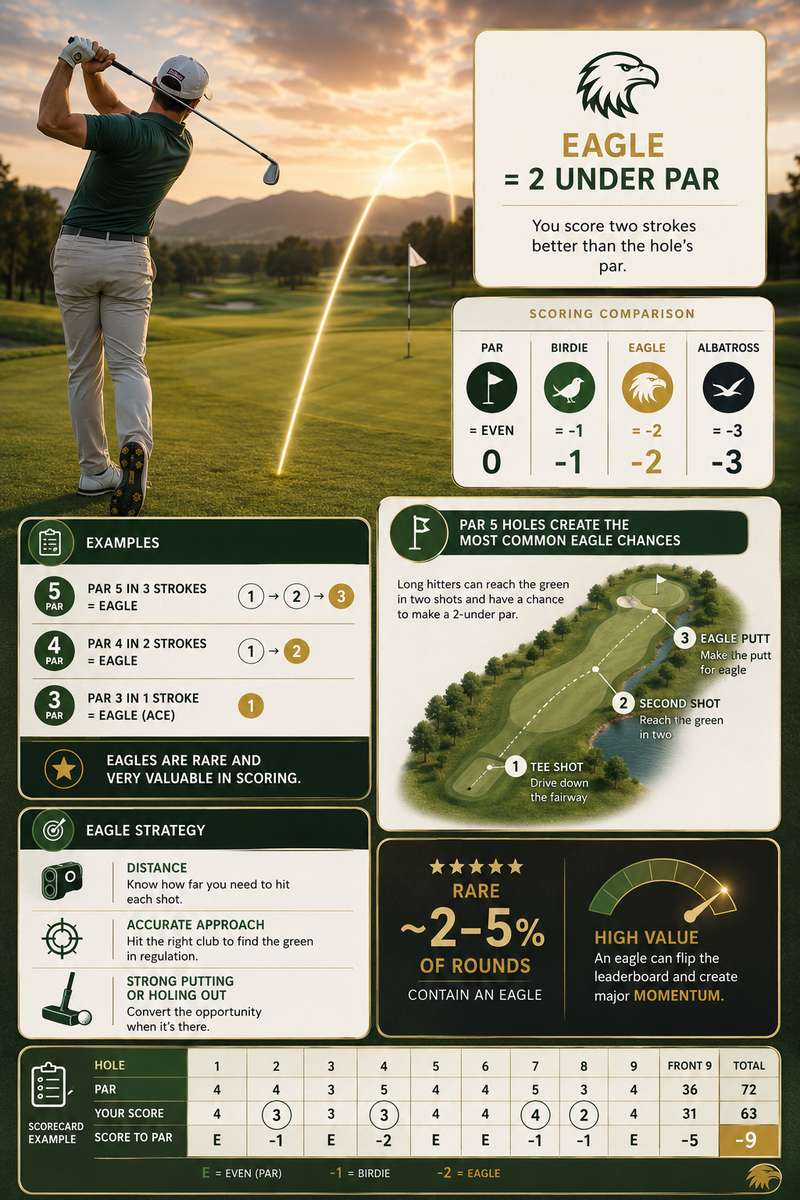
An eagle in golf is a score of two strokes under par on a single hole — for example a 3 on a par‑5 or a 2 on a par‑4. It sits above a birdie in the scoring hierarchy and below an albatross. Understanding eagles helps beginners read scorecards and helps players and fans recognise why certain holes and decisions create genuine scoring swings.
Quick summary: An eagle = two under par on a hole. The term grew from the same language that created “birdie” and is much rarer than a birdie. Most eagles happen on par‑5s where reaching the green in two makes a two‑putt or one‑putt eagle possible.
Quick access: Definition · Why eagles are rare · Par‑5 strategy
CLEAR DEFINITION
An eagle in golf is a score two strokes below the hole’s par. Common examples: scoring 3 on a par‑5 or scoring 2 on a par‑4. The PGA and golf glossaries define the term this way and place it one tier better than a birdie (one under par).
HOW IT WORKS
Technically, an eagle simply records as −2 for that hole on a scorecard. It occurs when a player completes the hole in two fewer strokes than the hole’s par. Because par reflects the expected number of strokes for a skilled player, achieving two fewer requires either long approach distance, exceptional shotmaking, or both.
WHY EAGLES ARE RARE AND VALUABLE
Eagles are rarer than birdies because they demand a larger gap between actual strokes and expected strokes. That rarity makes each eagle especially valuable in stroke play, where a two‑stroke swing on a hole can separate competitors quickly. Historically, the language around “eagle” developed as a natural step above “birdie,” signalling a notably better score.
PAR‑5S AND WHY THEY CREATE EAGLE CHANCES
On professional tours and in general analysis, most eagle opportunities come on par‑5 holes. Long hitters can often reach or nearly reach a par‑5 green in two shots, turning a successful approach and one or two putts into an eagle. Course design that rewards length, reachable par‑5s, and receptive greens increases eagle frequency relative to shorter holes.
SCORING AND FORMAT
In stroke play, an eagle reduces a player’s total by two strokes for that hole, making it a powerful score. In match play, an eagle can win a hole decisively. Eagles sit between birdies and albatrosses in common scoring terminology: birdie = −1, eagle = −2, albatross (also called “double eagle” in North America) = −3.
COMMON MISUNDERSTANDINGS
Beginners sometimes assume an eagle always requires a hole‑out from far away; in reality it can come from a standard sequence (for example, drive, long approach to two‑putt on a reachable par‑5). Another confusion is terminology: an albatross is not the same as an eagle — it is three under par and much rarer.
GOLF ART, VISUAL LANGUAGE, AND CLUBHOUSE CULTURE
Eagles carry an aspirational image that appears often in vintage golf posters and clubhouse prints: long drives, dramatic approaches over water, and players celebrating a remarkable chance. Prints of famous par‑5s or iconic tee shots resonate because those holes are where eagles most often occur, making them natural subjects for wall art and study decor.
CLOSING INTERPRETATION
An eagle is a clear, measurable sign of excellent play: two strokes better than expected on a hole. For beginners it’s a useful scoring milestone to recognise on a scorecard; for players and fans it highlights where length, strategy, and risk‑reward on par‑5s converge. In visual culture and clubhouse decor, eagles symbolize the dramatic moments that define rounds and seasons — rare, decisive, and memorable.
Author: Cynthia D.