What handicap do you need to become a professional golfer?
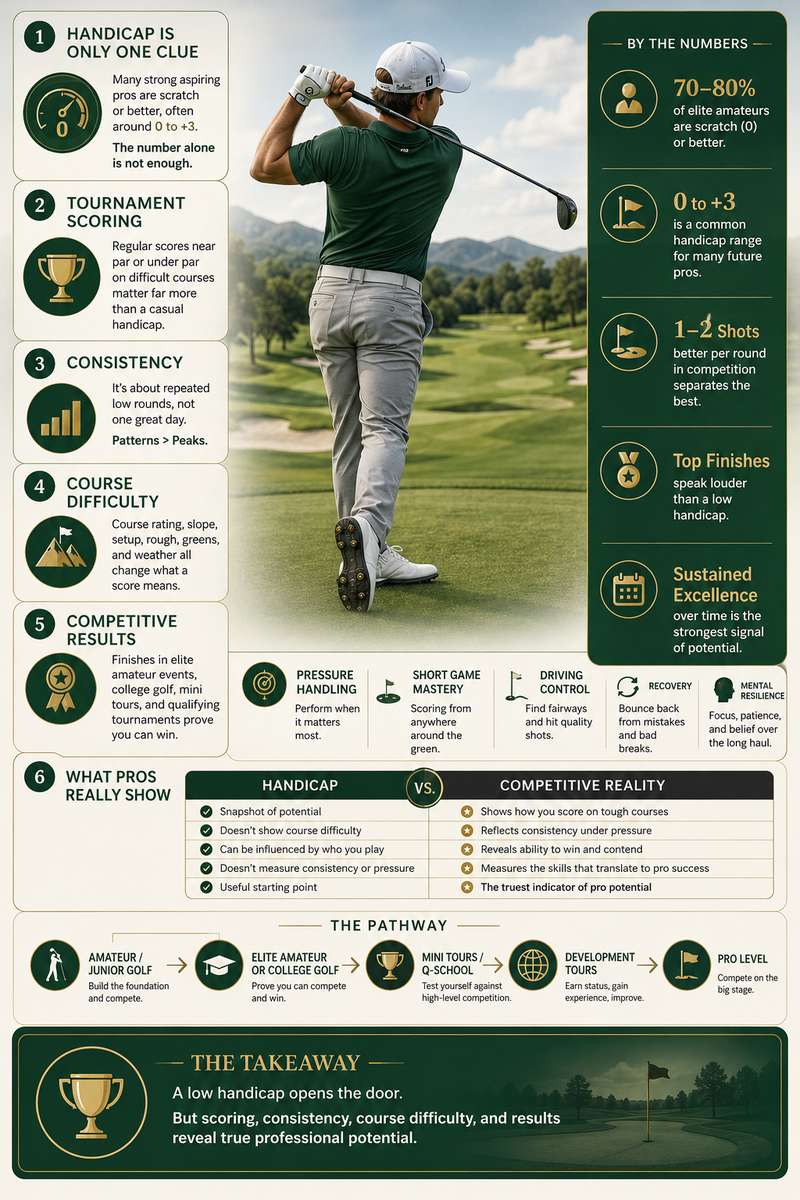
Ask any ambitious amateur: what handicap do you need to become a professional golfer? The short, honest answer is: a Handicap Index alone cannot and does not determine professional readiness. Handicaps measure recent recreational scoring adjusted for course difficulty; professional golf is decided by low gross scores under pressure, repeatable tournament performance and competitive results.
Quick answer
An official WHS/USGA Handicap Index is useful for recreational fairness and some championship entry limits, but it does not capture the tournament skills, pressure scoring and consistent low-gross rounds that define success at professional level.
What this article reveals
- How the World Handicap System works and what it measures.
- Which skills and results professional selectors actually value beyond a handicap number.
- Why tournament scoring, consistency and course-specific performance matter more than a single index.
Why a Handicap Index is only part of the picture
The World Handicap System (WHS) was created by national authorities to allow fair recreational competition across courses by referencing recent scores, course rating and slope. A Handicap Index is calculated from a player's recent rounds and is intended to reflect typical scoring potential for casual or club play.
However, WHS/USGA handicaps are an amateur construct. Major professional tours do not use Handicap Indexes in competition; professional events are played as low-gross stroke play where medal-style scoring, not net scoring, decides results. That structural difference explains why a handicap cannot stand in for tournament readiness.
What a Handicap Index actually measures — and what it misses
A Handicap Index aggregates recent scoring history adjusted by course rating and slope so players of different abilities can compete fairly. It smooths out occasional very good or bad rounds by drawing on a set of recent scores.
What it misses is critical for professional golf: the ability to post low gross scores repeatedly under tournament conditions, to manage recovery shots and to perform on courses set up far tougher than a typical club day. It also does not measure match-play savvy, head-to-head competitiveness, or how a player handles the cumulative stress of multiple competitive rounds.
Tournament scoring and consistency: the true testing ground
Tournaments expose players in ways casual rounds do not. Professionals and successful aspiring pros are judged on repeatability — not just one front-nine blitz. Four-round events, travel, tight pin positions and tournament greens create a different environment: small margins in approach proximity, scrambling and putting become decisive.
Consistent low-gross scoring shows a player can translate ability into results. National and tour selectors look for golfers who reliably place well in strong fields, not only those with a low Handicap Index recorded in club play.
Skills beyond the index: short game, pressure putting and course-type performance
Professional-level competition demands tournament-hardened short-game and putting skills: holing long putts under pressure, executing delicate recoveries from challenging lies, and managing risk on demanding hole setups. A Handicap Index derived from mixed casual rounds does not distinguish these tournament-specific competencies.
Course type matters. Performance that’s strong on tame parkland layouts may not translate to firm links or championship setups. Professional evaluation therefore weighs course-specific results and adaptability.
How governing bodies and championships treat handicap
Handicap Indexes do have formal uses: many national bodies and championships set maximum-index requirements for amateur eligibility. For example, some elite amateur entry rules reference precise Handicap Index limits for eligibility. That shows handicaps can be gatekeepers for entry to selected events, but they remain eligibility tools rather than predictors of pro success.
In short: a handicap can qualify an amateur to enter certain championships, yet it does not replace the need to demonstrate low-gross tournament scoring and competitive results.
Hidden misconceptions and the obstacles they hide
Mistake one: treating a low Handicap Index as proof of tournament resilience. Because a handicap averages recent scores, it can disguise volatility—players who shoot very low occasionally but regress under stress will still look better on paper than their tournament record suggests.
Mistake two: assuming equipment or practice volume alone closes the gap. The WHS does not and cannot measure a golfer’s capacity to replicate pressure performance, travel preparations, recovery between rounds, or strategic decision-making on difficult tees and greens.
What college coaches, selectors and tour organisers actually notice
Decision-makers look for consistent tournament performance in relevant events: head-to-head results, placings in strong fields, and evidence of performing in championship conditions. They value a pattern of low gross scoring and smart course management under tournament constraints.
Handicap is a supporting data point for eligibility or initial screening. The decisive evidence is strong competitive results and demonstrated repeatability where it matters.
How to turn a handicap into meaningful evidence of pro potential
If your Handicap Index is improving, ask how that improvement shows up in tournaments. Key markers include consistent low-gross rounds in event conditions, better scrambling and putting under pressure, and strong results on tougher course setups. Those are the signals scouts and event organisers read.
Play increasingly strong events, measure repeatability across rounds, and prioritise tournament scenarios in practice — that is how a handicap becomes part of a larger demonstrable record.
Closing interpretation: the number helps, but the story matters more
The question what handicap do you need to become a professional golfer points to an understandable desire for a neat threshold. The verified reality is more nuanced: WHS/USGA handicaps are important for recreational fairness and for meeting some amateur eligibility rules, yet professional golf evaluates low-gross tournament scoring, consistent results across conditions, and competitive temperament.
If your index is low, celebrate the progress—but treat it as an invitation to prove the same scoring under tournament pressure and in stronger events. That pattern of results, not the index itself, is the currency of progression toward professional competition.
Author: Cynthia D.