Can a Scratch Golfer Become a Professional Golfer?
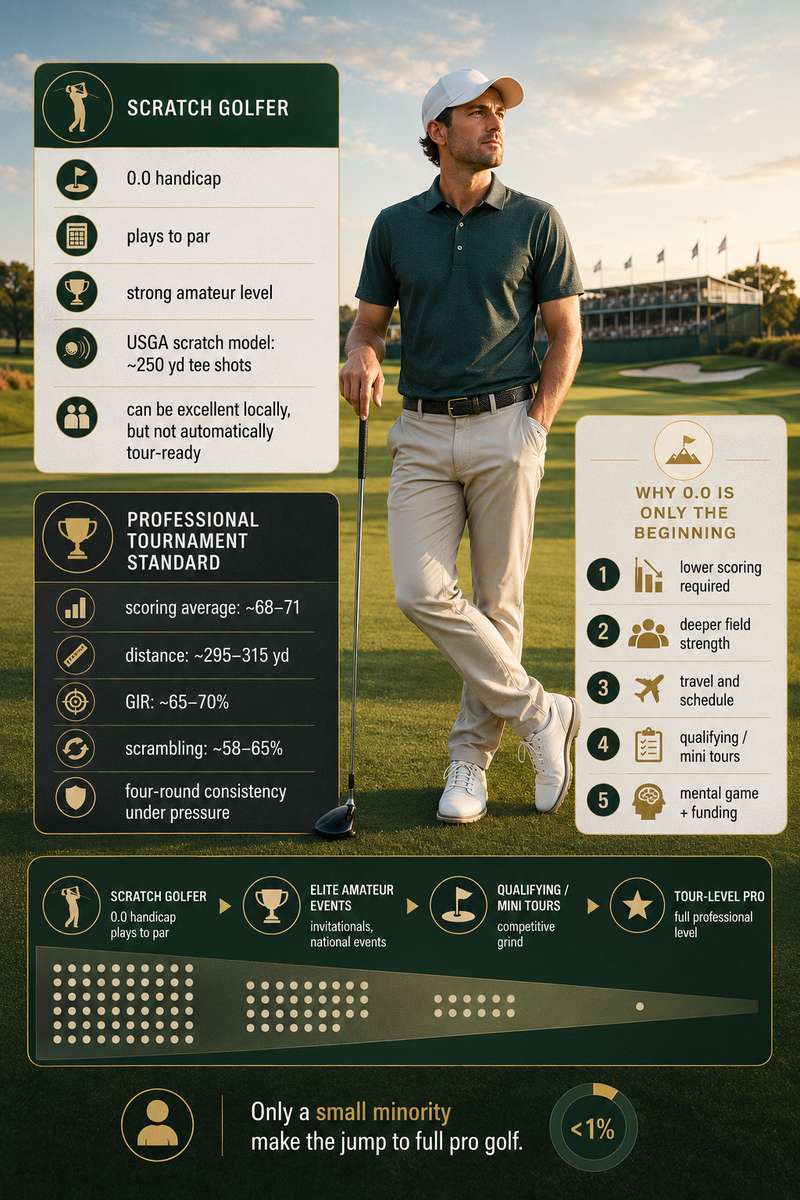
Scratch golfers—defined by the World Handicap System as players with a Handicap Index of 0.0—represent the baseline the course-rating system uses to measure difficulty. That status is an important milestone, but it does not by itself make someone a touring professional.
Short answer: yes and no. A scratch golfer has the technical foundation to pursue professional golf, yet tour membership and success demand many additional, measurable ingredients: lower sustained scoring under tournament setups, repeatable shotmaking, qualification through tour pathways, and the off-course commitments of life as a professional.
Quick answer
Being a scratch golfer means you meet the established baseline used in course rating. Becoming a touring professional, however, requires earning status through qualifying routes or tour membership and performing reliably at a level well above the scratch baseline under tournament conditions.
What this article reveals
- How the Handicap Index and course rating treat a scratch player as the baseline.
- Why professional tournament scoring routinely sits below typical scratch expectations.
- The difference between turning professional and earning tour membership.
- Which non-handicap factors decide whether a scratch player can progress to tours.
What is a scratch golfer—and what does 0.0 mean?
The World Handicap System and the USGA define a scratch golfer by a Handicap Index of 0.0. Course Rating and Slope use the scratch standard to estimate how a scratch player would be expected to score on a given course under normal conditions. In short, scratch is a statistical baseline used to equalise play across different venues.
Why scratch is not the same as professional tournament standard
Professional fields, especially on major tours, routinely produce scoring averages well below what the scratch baseline predicts for typical rated conditions. Tour scoring statistics show that touring professionals average strokes-per-round that are better than par on many tournament setups—levels of consistent scoring that exceed the USGA’s scratch reference. The result: a 0.0 Handicap Index indicates strong amateur ability, but it is not evidence of the repeatable scoring necessary to compete week to week in professional events.
What becomes required beyond a low handicap
Moving from scratch amateur to touring professional brings several distinct requirements that the Handicap Index does not measure. These include sustained tournament scoring under tougher course setups, consistent short-game and putting under pressure, strategic course management for championship conditions, and the non-playing demands of professional life. Crucially, tour membership is earned through qualifying systems and results, not by handicap alone.
Turning professional versus earning a tour card
The USGA defines a professional in rules and amateur-status terms—someone who plays the game as their profession or holds membership of a Professional Golfers' Association or a tour. But “turning professional” is different from earning a tour card or regular starts. Major tours make membership and starts conditional on qualifying pathways: performance in qualifying events, points lists, money lists, or other eligibility categories. A scratch index does not grant automatic access to those categories.
How tours and qualifying work (conceptually)
Professional tours maintain eligibility systems that award status through performance: Q-Schools, qualifying series, developmental-tour results, or money/points lists. These pathways test competitive performance over multiple stages and events. Because these systems are performance-based, a baseline handicap is only relevant to the extent it correlates with the lower tournament scoring and consistency the pathways require.
What the Handicap Index misses—and where a scratch golfer is likely to be exposed
The Handicap Index measures expected scoring relative to course rating in ordinary conditions and helps equalise casual competition. It does not measure repeatability under tournament pressure, recovery from poor lies, or hole-by-hole efficiency on prolonged, difficult setups. Tour events often present firmer surfaces, tougher pin positions, and greater penalty for errant shots—situations that expose weaknesses in short-game proximity, scrambling, and putting that handicaps do not show.
The practical differences you will notice on a championship course
On a demanding tournament setup, small margins matter: approach-shot distance control, the ability to hit precise trajectories, and short-game proximity under sustained pressure are what separate a single scratch round from repeated sub-par rounds. Professional scoring statistics reflect field-wide advantages in these areas; the Handicap Index alone does not capture the consistency of these skills across multi-round events.
Pathway and development realities for a scratch golfer
For a scratch player considering a professional route, the path is practical and concrete: continue to enter stronger tournaments, test yourself in qualifying formats, and seek results that prove consistent scoring under tougher conditions. Remember the distinction between becoming a club or teaching professional—roles with their own certification systems—and joining a touring circuit where status is earned through performance. The Handicap Index is a helpful starting point but not a passport.
Final interpretation — what a scratch golfer should do next
If you are a scratch golfer wondering whether you can become a professional, treat 0.0 as a necessary foundation, not the finish line. Use it as a diagnostic: it shows you can play to a high standard on rated courses. From there, focus on tournament-specific skills, repeated scoring under pressure, and entering qualification routes that test performance rather than ability on a single day. Recognise the difference between declaring professional status and earning tour status through qualifying systems.
Author: Cynthia D.