Albatross in Golf Explained: What Three-Under-Par Means and Why It’s So Rare
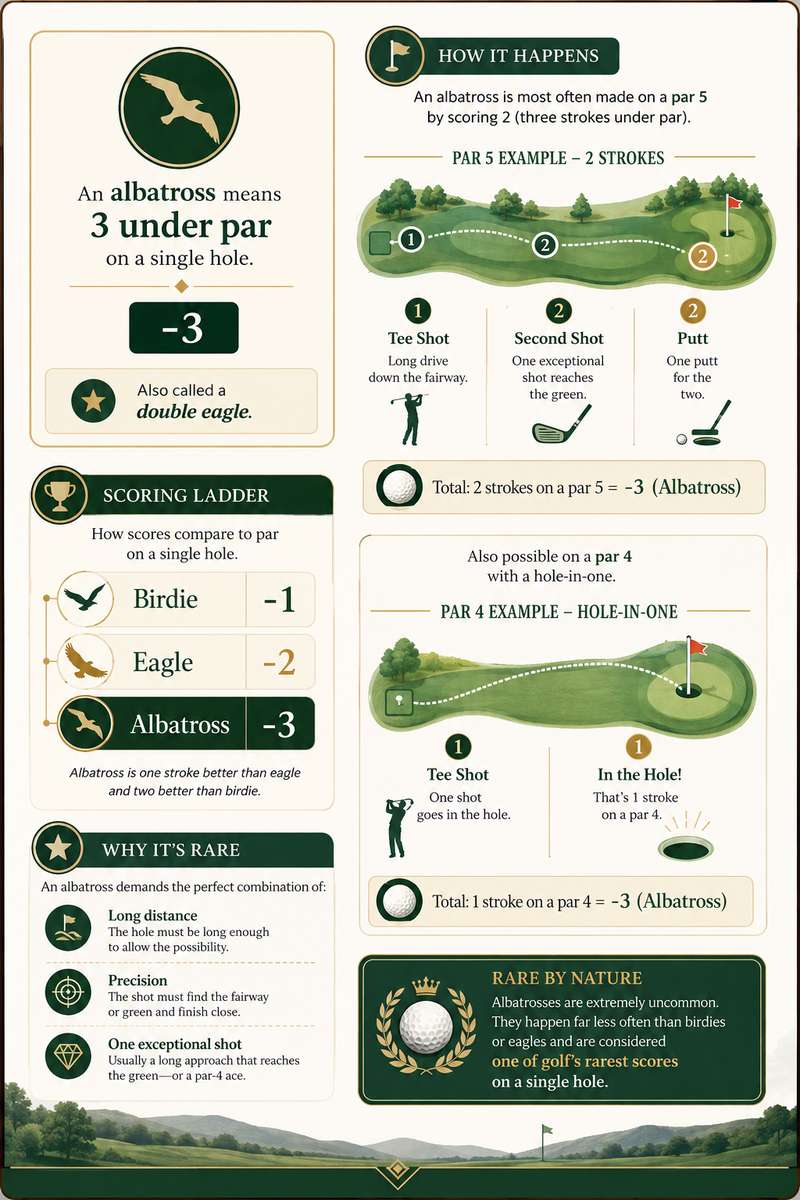
An albatross in golf — also commonly called a double eagle in American usage — is a score of three-under-par on a single hole. It sits above the more familiar birdie and eagle on the scoring ladder, and because it almost always requires holing a long shot or an extraordinary hole-in-one on a short par-4, it remains one of the rarest feats in the sport.
Quick summary: An albatross (double eagle) = three-under-par on a hole. Birdie = one-under, eagle = two-under. Albatrosses are uncommon because they usually require holing a long approach on a par-5 or a rare par-4 ace.
Quick access: Definition | Why it’s rare | Birdie, eagle, albatross
CLEAR DEFINITION
An albatross (double eagle) is a score of three-under-par on a single hole. In common scoring terms, a birdie is one-under-par, an eagle is two-under-par, and an albatross is one stroke better than an eagle — three-under.
HOW IT WORKS
The situations that produce an albatross are straightforward in concept but uncommon in practice. On a long par-5, a player can make an albatross by holing the second shot from off the fairway or a long lay-up position. On an unusually short par-4, a player might record an albatross with a hole-in-one, though such par-4 aces are exceptionally rare. Course layout and hole length therefore determine the realistic opportunities to score three-under on a hole.
WHY IT’S RARE
Albatrosses are extremely rare because they typically require holing out from a long distance or the unusual circumstance of a par-4 hole-in-one. Most holes do not present a practical line of play that allows a player to reach the green in so few strokes, and the long shots involved demand both distance and precise accuracy. Tour and historical records treat albatrosses as notable events precisely because they occur so infrequently.
COMPARISON: BIRDIE, EAGLE, ALBATROSS
The simplest way to read scoring is by strokes relative to par. Birdie: one-under-par. Eagle: two-under-par. Albatross (double eagle): three-under-par. Each step down from par represents an increasingly rare and valuable score in stroke play and match play formats, with the albatross representing a very significant swing in a single hole when it happens.
HISTORICAL CONTEXT
Both names — albatross internationally and double eagle in American usage — are used by reputable glossaries and authorities. The two terms are treated as synonyms in modern golf language. Famous historical examples of a double eagle have entered golf lore and helped popularize the phrase "double eagle" in the United States.
SCORING AND TOURNAMENT NOTES
Tours and statistical resources track albatrosses as rare, noteworthy events. When they occur in professional tournaments or major championships they are recorded and often highlighted by media guides and historical lists because of their scarcity and the immediate impact such a score can have on a player’s round.
GOLF ART AND VISUAL LANGUAGE
The drama of an albatross — a long, airborne approach disappearing into the hole or an improbable par-4 ace — translates well to golf posters and vintage wall art. Images that emphasize flight, trajectory, and the course landscape capture the moment’s rarity: long fairways, distant flags, and a single ball dropping on the green make for striking clubhouse decor and study prints that celebrate golf’s unusual feats.
CLOSING INTERPRETATION
Understanding an albatross clarifies how scoring steps away from par and why certain shots become memorable. It connects course design, distance, and a single stroke’s potential to change a round. Whether you’re learning scoring terms, following tournament folklore, or choosing a piece of golf art for a wall, the albatross symbolizes one of the game’s most uncommon rewards: a perfect blend of power, accuracy, and a bit of sporting luck.
Author: Cynthia D.