
Birdie vs Eagle: How Each Score Relates to Par and Changes a Round
A birdie and an eagle are two of the most celebrated scoring outcomes in golf because each improves a player's score relative to par. Knowing exactly how they relate to par, why one occurs far less often, and how they show up on a scorecard helps beginners read a round and gives fans a clearer view of tournament swings.
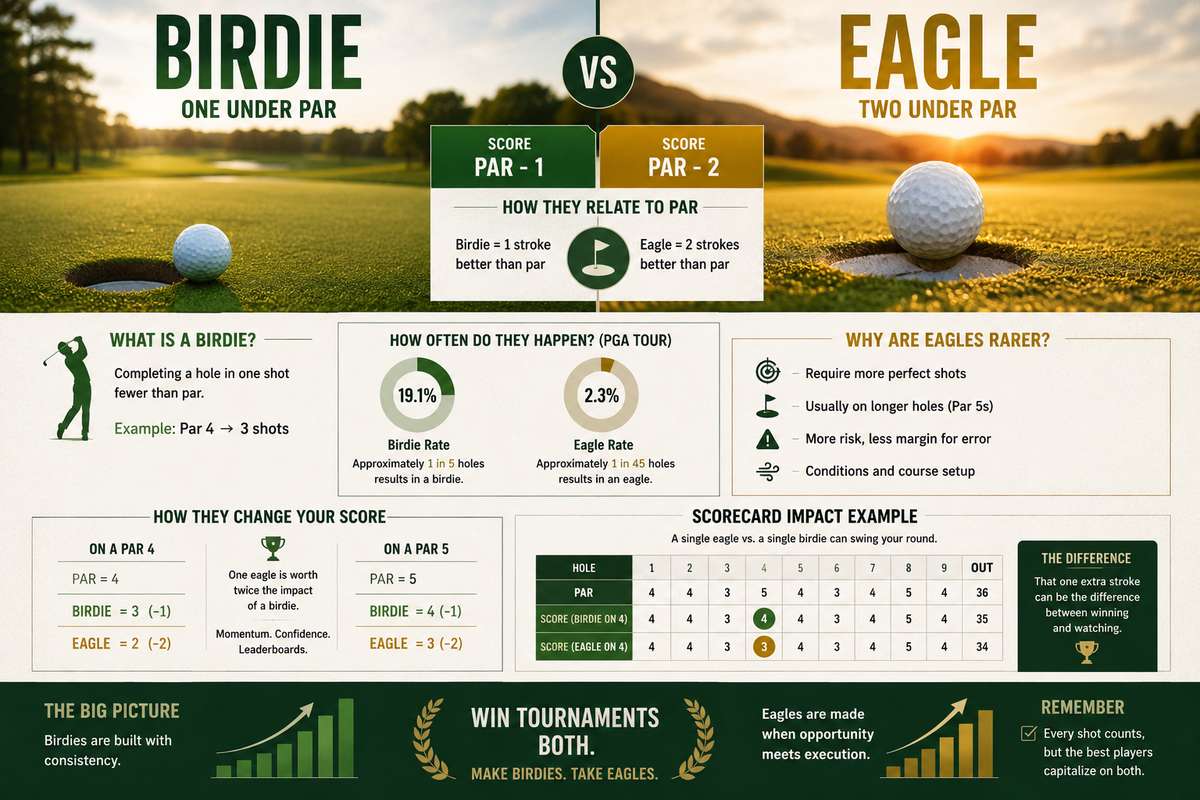
Quick summary: A birdie is one under par on a hole; an eagle is two under par. Birdies are common enough to be tracked separately from eagles in official stats, while eagles are substantially rarer and therefore carry extra weight on leaderboards and in special scoring formats.
Quick access: Definition • Scoring impact • Why eagles are rarer
CLEAR DEFINITION
In simple terms, a birdie is a score of one stroke under par on a hole (for example, a 3 on a par-4). An eagle is two strokes under par on a hole (for example, a 3 on a par-5). These definitions are the standard usage in golf dictionaries and governing-body explanations.
HOW IT WORKS
Par is the benchmark for each hole shown on the scorecard. When a player completes a hole, the difference between their strokes and the hole's par determines whether the result is a birdie, eagle, bogey, or another scoring term. Scorecards and leaderboards record that difference, and official stat providers distinguish categories such as "birdies or better" and separate "eagles" for analysis.
SCORING AND FORMAT
On a scorecard or leaderboard a birdie reduces a player's cumulative score relative to par by one stroke; an eagle reduces it by two strokes. In stroke play this improves a player’s position directly; in match play the same holes might simply win the hole by one or two strokes depending on match scoring rules. Some scoring systems, like Stableford or modified Stableford, assign different point values to birdies and eagles to reflect their differing rarity and importance.
WHY EAGLES ARE RARER
Statistical tracking by tours and research summaries from governing bodies show that eagles are substantially less common than birdies. Eagles require either reaching a longer par in fewer strokes (for example, getting to a par-5 green in two shots) or holing a very long approach or putt, situations that occur less frequently than the typical birdie opportunities around the green.
CLUBS, SHOT MAKING, AND WHERE THEY COME FROM
Birdies most often arise from solid approaches, good chipping and reliable putting — a precise iron or wedge shot that leaves a makable putt. Eagles typically involve longer clubs or riskier aggressive play: reaching a par-5 in two with a long second shot, holing a long approach, or converting a lengthy putt. Because the situations that create eagles require distance, accuracy, and often favorable course setup, the make-rates for eagles are lower than for birdies.
COURSE ARCHITECTURE AND STRATEGY
Course features such as hole length, doglegs, bunkers, water, pin position and wind influence how likely birdies and eagles are. Shorter par-4s and reachable par-5s create eagle opportunities; well-protected greens and back pins make birdies harder. Watching these features during a broadcast helps viewers understand when a player is hunting a birdie or taking a risk for an eagle.
STATS, TOURNAMENT CONTEXT, AND VALUE
Tours track birdie rates and eagle counts separately because their competitive and statistical impacts differ. A string of birdies steadily lowers a player’s score; a single eagle can leapfrog competitors on a leaderboard. Some events and formats explicitly reward eagles more heavily in point-based scoring to mirror that higher value.
COMMON MISUNDERSTANDINGS
Beginners sometimes confuse the terms or assume an eagle is simply a very good birdie. The precise distinction is always relative to par: birdie = one under, eagle = two under. Also, because eagles are rarer, seeing "birdies or better" grouped in stats can mask how few of those "betters" are true eagles.
GOLF ART AND VISUAL LANGUAGE
Birdies and eagles carry strong visual and emotional imagery that appears in vintage posters and clubhouse art: the triumphant putt for birdie, or the dramatic aerial approach that sets up an eagle, both translate well into iconic swing silhouettes and classic course vistas. Posters often celebrate the decisive shot or the course view tied to memorable scoring moments, making these scores attractive motifs for decor and study art.
CLOSING INTERPRETATION
Understanding birdie vs eagle in golf is a simple numerical lesson — one stroke under par versus two — but its practical effect in a round is larger. Birdies are the steady currency of good scoring; eagles are rarer windfalls that can change leaderboards and momentum. Recognizing when a hole or an approach offers a birdie chance versus an eagle opportunity helps players choose clubs, shape shots, and read broadcasts, and it gives collectors and fans richer imagery for posters and clubroom walls.
Author: William L.