Are professional golfers born talented or trained? A clear, evidence-backed view
Are professional golfers born talented or trained? The short, evidence-backed answer: neither factor works alone. Contemporary research shows elite golf arises from interacting ingredients — natural coordination and physical traits help, but deliberate practice, coaching, strength & conditioning, and sport psychology are essential to turn potential into repeatable performance.
The honest answer
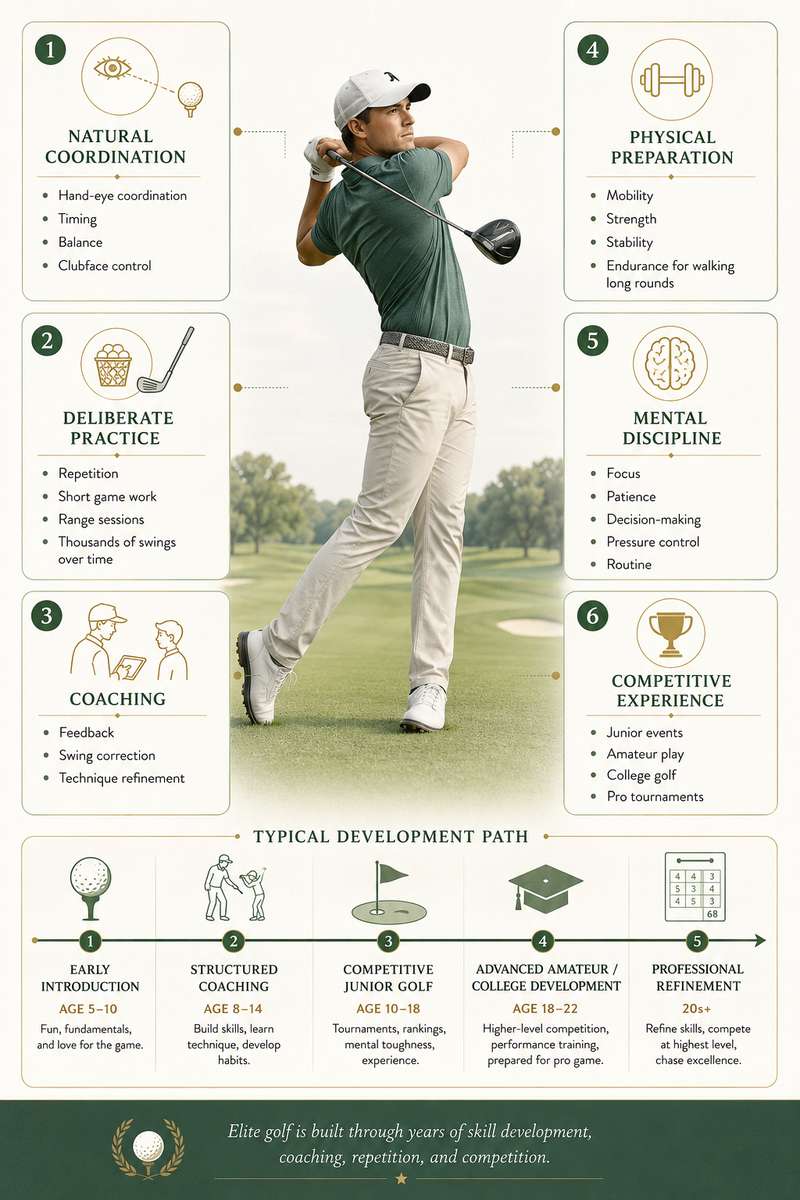
Evidence from systematic reviews and empirical studies positions deliberate practice, coaching, physical preparation and psychological skills alongside innate coordination. Each is necessary; the elite result is their interaction, not one single cause.
What this article reveals
- Which traits are reliably linked to higher golf proficiency.
- How structured practice and coaching change a golfer’s trajectory.
- Where strength & conditioning and sport psychology fit into elite preparation.
- Why talent alone rarely produces tour-level consistency.
Defining the question: what do we mean by “born” and “trained”?
Asking whether golfers are born or trained is really asking how much innate attributes (coordination, balance, body flexibility) versus acquired inputs (deliberate practice, coaching, S&C, psychological training) determine elite performance. The verified literature treats both as contributors that interact over long-term development rather than as alternatives.
What the research actually says
Systematic and mixed-methods reviews identify multiple interacting factors for professional development in golf: technical practice, psychological skills, coaching, strength & conditioning, and information/feedback tools. Separate empirical work on deliberate practice supports structured, focused practice with feedback as central to skill acquisition in golf. Cross-sectional studies demonstrate that higher-proficiency golfers show greater strength, flexibility and balance than lower-proficiency peers, while reviews of S&C interventions report improvements in clubhead speed and related performance measures.
Why talent matters — but isn’t enough
Natural coordination and physical attributes give some players an early advantage: easier motor learning, more efficient balance, and a physical base for power and control. However, contemporary literature emphasises interaction: those innate traits only translate into elite performance when combined with long-term, structured practice, high-quality coaching, competition exposure and supporting preparation.
The practice piece: deliberate practice and feedback
Deliberate practice — purposeful, structured work with clear goals and feedback — is a proven component of skill development in golf. The research highlights that practice quality matters: drills that target tournament tasks, immediate and accurate feedback (including video analysis), and progressive challenge accelerate skill acquisition more reliably than undirected time on the range.
Coaching and information tools
Coaches provide technical direction, planning and the long-term framework that turns practice into development. Governing bodies and coaching frameworks emphasise coach education, long-term planning and whole-person development. Feedback tools such as video and objective measurement support precise corrections and help players develop repeatable mechanics and on-course strategies.
Strength & conditioning and physical preparation
Evidence shows S&C programs improve golf-related physical characteristics and can enhance clubhead speed and shot performance. Surveys of touring professionals report high rates of engagement with structured resistance training and in-event preparation. Physically stronger, more flexible and better-balanced golfers possess measurable advantages that support shot quality and injury resilience — but these benefits are gained through training, not gifted alone.
Sport psychology and mental skills
Meta-analytic evidence supports the impact of psychological techniques — imagery, mindfulness, self-talk, anxiety management — on performance. Golf-specific research highlights these constructs as vital for elite play, helping golfers perform consistently under pressure, manage competitive anxiety and sustain concentration across rounds. Mental skills are trainable and form a core component of the modern preparation package.
How the factors interact in development
The key takeaway across reviews is interaction. Innate coordination gives advantage in early skill acquisition; deliberate practice refines technical and tactical skills; coaching integrates practice into long-term plans; S&C builds physical capacity; and sport psychology builds competitive robustness. None of these alone reliably produces an elite professional — the combination over years does.
Common misconceptions and hidden obstacles
Misconception: a beautiful swing equals a tour player. Reality: swing aesthetics are no substitute for repeatable shotmaking, course strategy and pressure performance. Misconception: more hours always win. Reality: unguided volume without feedback or periodisation yields slower progress and risk of injury or burnout. Hidden obstacles include poor coaching integration, weak feedback systems, inadequate physical preparation, and undertrained psychological skills.
What separates strong amateurs from elite professionals
Research-backed differences are not only technical. Elite players typically display better physical measures, structured preparation habits, and developed psychological skills, all organised by long-term coaching. The shift from high-level amateur to touring professional is less about a single metric and more about consistent integration of practice, fitness, feedback, and competitive poise over time.
Practical tests you can use to assess potential
Rather than searching for a magic threshold, use indicators: rapid improvements with structured coaching, ability to translate range performance into competitive scoring, measurable gains from S&C work, and resilience under tournament pressure with psychological strategies. Those signals show the interaction between innate skill and trained capabilities is producing real development.
Closing interpretation
Are professional golfers born talented or trained? The evidence reframes the question: talent provides a head start, but elite golf is produced by sustained, deliberate practice, informed coaching, targeted physical preparation and psychological skills. If you’re wondering what to prioritise, the research points to integrated development — not just more hours, and not expecting talent alone to carry a career. The practical path is building those elements together over time.
Author: Alex R.