
How much better is a tour pro than a scratch golfer? A clear-eyed breakdown
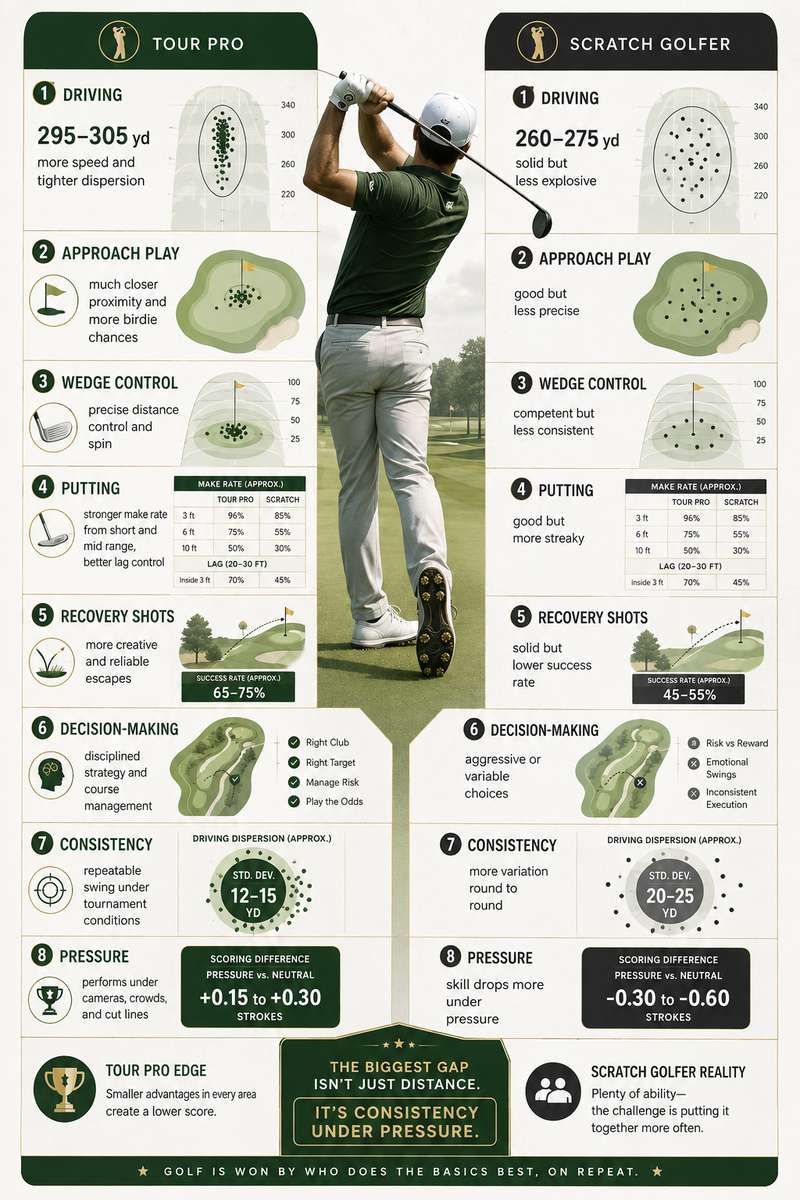
Ask a scratch golfer and a PGA Tour professional to play the same championship course and you will see familiar shots and shared vocabulary—but not the same outcome. The honest short answer: tour professionals outperform scratch amateurs across almost every meaningful skill area, with the clearest, measurable edge in driving distance and consistent gains in approach shots and the short game. That gap is real, measurable in some areas, and rooted as much in repeatability, course management and pressure execution as in raw distance.
Quick answer
Tour pros typically drive substantially farther than scratch golfers, and they convert that distance into scoring advantage because they also outperform scratch golfers on approach shots, around-the-green play, and in consistent tournament execution. The strokes-gained framework highlights approach and short game as the biggest pro advantages; driving distance is a clear, measurable gap.
What this article reveals
- Which skill areas show measurable differences and which are described qualitatively by analytics.
- Why distance matters but doesn’t alone make a professional.
- How repeatability, recovery and pressure separate pros from scratch amateurs.
Defining the standard: what we mean by a "scratch golfer" and a tour pro
The USGA defines a scratch golfer as a player who can play to a Course Handicap of zero on rated courses — roughly a Handicap Index near 0.0. A PGA Tour professional is a touring player measured by competition data such as ShotLink and official PGA TOUR statistics. These are distinct populations: a scratch amateur represents the high end of the public-handicap spectrum, while tour professionals are measured across season-long fields with ShotLink-recorded performance.
Driving: the clearest measurable gap
One of the most concrete differences is distance. PGA TOUR seasonal statistics and USGA distance reports show tour averages in the high 200s (commonly around 290–300 yards depending on the metric and season). Published amateur and scratch-driver benchmarks are substantially lower (commonly cited around the low-to-mid 200s). That distance gap is verifiable in official driving-distance tables and USGA reports and creates practical scoring advantages—shorter approach clubs, different angles into greens, and different strategic choices.
Approach play, wedge control and the short game: where pros gain most
Analytics built on the strokes-gained framework identify approach shots and around-the-green performance as where professionals typically outscore amateurs most consistently. Mark Broadie’s strokes-gained method decomposes scoring into driving, approach, short game and putting; ShotLink and similar analyses show pros consistently pick up strokes on amateurs in approach and around-the-green categories. Those gains come from repeatable distance control, tighter dispersion into greens, and better execution under tournament conditions.
Putting and recovery: pros are more reliable, not uniformly superior
Putting differences are more nuanced. Strokes-gained decomposition treats putting separately and shows professionals can gain strokes with short- and long-putting skill, but the largest aggregate pro advantages are usually tee-to-green (approach and short game) rather than putting alone. Recovery shots—bunker play, difficult lies and scrambling—are part of the around-the-green category where pros again tend to outperform scratch golfers in consistency and repeatability.
Decision-making and course management: invisible but decisive
Numbers tell part of the story; strategic intelligence fills in the rest. Tour professionals operate within tournament strategy: conservative choices when a par is valuable, aggressive lines when payoff is clear, and an ability to judge risk relative to the field and conditions. Those decisions are visible in shot maps and repeatedly influence scoring across a round and a season. A scratch golfer may hit comparable individual shots, but decision-making under tournament incentives is a consistent pro advantage.
Consistency across rounds: why a single great round is not the same as tour performance
Qualitative and ShotLink-based evidence emphasises repeatability. Pros are measured over many rounds in varying conditions; their statistical edge is not a single low round but season-long stroke gains. This reliability arises from technical repeatability, preparation routines, course knowledge and tournament experience. A scratch amateur can shoot the same number on a good day, but sustaining that level—particularly across multiple rounds, courses and pressurized leaderboards—is the professional difference.
Performance under pressure: measurable proxies, not a single metric
Comparisons of pressure performance between amateurs and pros are complex. ShotLink and strokes-gained provide proxies (clutch-shot statistics, performance on critical holes, scoring around the green under stress), and those analyses are used by media and researchers to track how players gain or lose shots. The verified research notes that a standard, public metric directly comparing pros and scratch amateurs under pressure does not exist in a single table; nonetheless, the broader analytical picture shows professionals execute critical shots more consistently, contributing to their scoring advantage.
What ambitious scratch golfers should take away
If you are a scratch player wondering how far you are from tour level, focus less on one number and more on the combination that analytics show matters most: repeatable distance control (not only raw yards), tighter dispersion into greens, superior short-game recovery and decision-making in tournament situations. Measurable gaps (like driving distance) are real and important; so are less-visible elements (repeatability, course strategy, pressure execution) that aggregate across rounds.
Testing your limits: realistic checks and useful steps
Useful, non-proprietary ways to test potential are aligned with the strokes-gained categories: measure your distance relative to typical scratch benchmarks, track proximity-to-hole from approaches and recovery success around the green, and evaluate putting consistency across many rounds. Coaches and analysts use these same categories to find whether a player’s profile is one of steady competitiveness or one that would need significant development to handle professional tournament demands.
Closing interpretation: a practical, honest perspective
How much better is a tour pro than a scratch golfer? The short, honest answer: measurably and meaningfully better in distance and consistently better across approach, short game and tournament execution. The strokes-gained framework and official distance reports give us the evidence that these are not just impressions. That gap reflects repeatability, decision-making and pressure handling as much as raw power. For ambitious players, the useful question is not whether pros are better—they are—but which parts of your own game require the most focused, measurable improvement to narrow the gap.
Author: Cynthia D.